
Step in the Right Direction: The 2026 ACC/AHA Cholesterol Guidelines
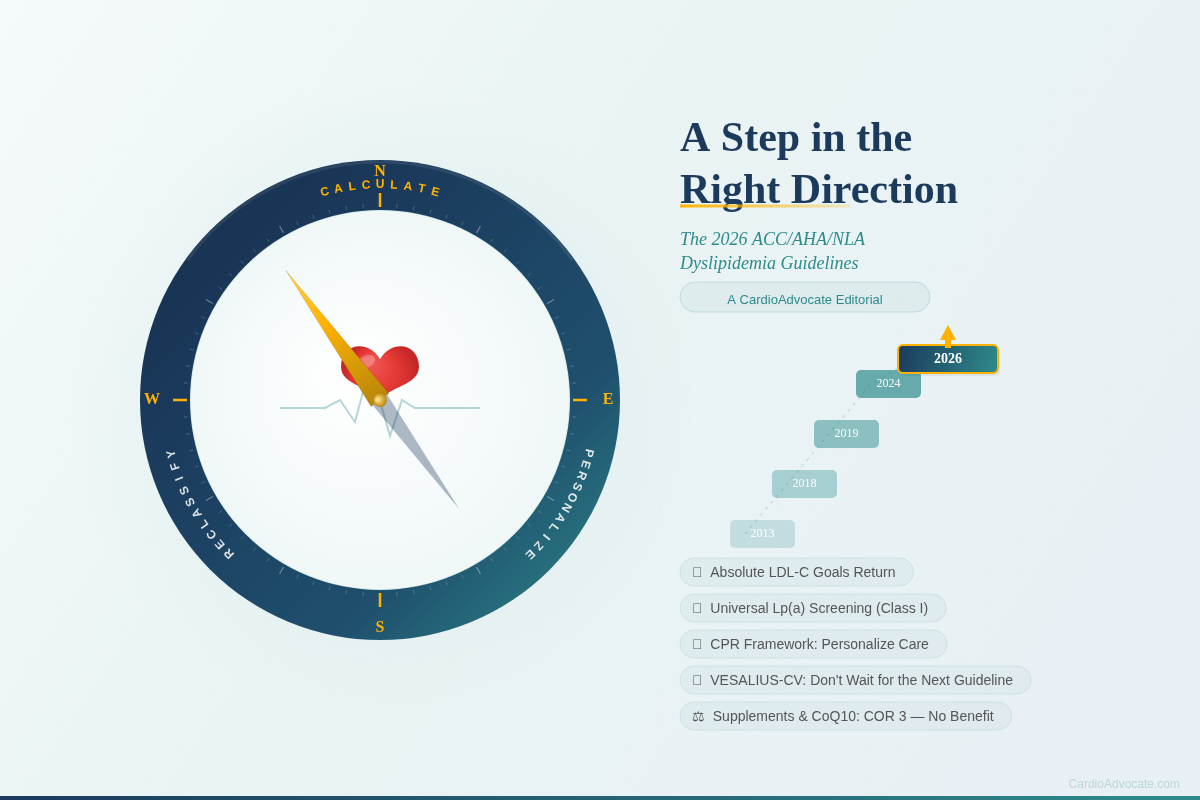
A Step in the Right Direction: The 2026 ACC/AHA Lipid Guidelines — What We Applaud, Where We Differ, and What VESALIUS-CV Means Right Now
A CardioAdvocate Editorial
Finally.
After years of watching U.S. guidelines lag behind the ESC, AACE, CCS, and expert consensus, the 2026 ACC/AHA/NLA Dyslipidemia Guidelines represent the most significant step forward in American lipid management in over a decade. The 102-page document from the writing committee led by Blumenthal and colleagues is comprehensive, forward-thinking, and genuinely moves the needle.
But let's be honest: much of what feels "new" in these guidelines is what preventive cardiologists and lipidologists have been actually practicing for years. This proves a deeper point — we don't have to wait for guidelines to catch up to the evidence. The evidence is always moving forward. Guidelines eventually follow. The best clinicians don't wait.
What We Applaud
1. Absolute LDL-C and Non-HDL-C Goals Are Back
After 13 years of "percentage reduction only," concrete numbers to aim for have returned. This aligns with the ESC, AACE, CCS — and with what we've been doing. Patients and clinicians need targets. Period. A patient needs to know: "Your goal is LDL-C below 55." Not "reduce it by 50%." Not "do your best." A number. A bulls-eye. That's what these guidelines now provide, and we applaud the decision.
2. Universal Lp(a) Screening (Class I)
A sea change. CardioAdvocate has been advocating for this since day one. One in five people have elevated Lp(a). It's genetic — diet and exercise don't touch it. An Lp(a) level ≥125 nmol/L (or ≥50 mg/dL) confers independent cardiovascular risk — with nmol/L being the preferred assay. Yet for decades, most clinicians never measured it. Now, every adult should know their number. This is clarity the field desperately needed.
3. CAC Prominence — Without the Zealotry
Not full-fledged CAC evangelism, but significantly better. Tiered AU-based recommendations give clinicians actionable thresholds. And here's the practical win: incidental CAC on noncardiac CT getting a Class I recommendation is brilliant. Stop ignoring what the radiologist already found. If the finding is there, act on it.
4. Earlier Treatment Emphasis
LDL-C ≥160 mg/dL beginning at age 30 with elevated 30-year risk. This is interesting not just for ASCVD prevention but potentially for aortic stenosis. Emerging data suggest calcific aortic valve disease is fundamentally a lipid disorder. It would be fascinating to monitor over the coming decades whether earlier aggressive lipid-lowering attenuates aortic stenosis incidence. Just an aside, but one worth planting.
5. Supplements: COR 3, No Benefit
We applaud the guts it took to formally weigh in. The SPORT trial data are compelling. Previous guidelines said nothing; ESC guidelines still don't explicitly comment. The ACC/AHA committee stepped up. Same goes for CoQ10 COR 3: No Benefit. Years of debate, settled.
6. The CPR Framework
Calculate-Personalize-Reclassify. Simple, memorable, and exactly the right philosophy: start with a calculator, personalize with risk enhancers, reclassify with CAC when uncertain. This is how good clinicians have always practiced. Now it has a name.
7. Insurance Authorization
Here's the practical win that doesn't get enough attention. Hard guideline recommendations make it easier to get PCSK9 inhibitors, bempedoic acid, and aggressive combination therapy authorized. A big thank you is in order.
8. Populations That Were Afterthoughts
HIV (REPRIEVE, COR 1), CKD, pregnancy — these populations now have dedicated, thoughtful recommendations.
Where We Continue to Differ
This is where expert voice shines — balanced disagreement backed by evidence.
1. CAC >300 vs. >1000 for Secondary Prevention Equivalence
The 2026 guidelines set the bar at CAC ≥1000 for treating like secondary prevention (LDL-C <55, non-HDL-C <85). We respectfully disagree. The ≥1000 threshold comes from comparing MESA data with the FOURIER trial placebo arm — showing similar MACE rates in MESA patients with CAC ≥1000 and stable secondary prevention patients. Fair enough. But here's the thing: the guideline's own supportive text acknowledges that individuals with a CAC score ≥300 have a risk of future ASCVD events comparable to cohorts with existing ASCVD — citing CONFIRM registry data, the CAC Consortium, and MESA. The guideline even gives a COR 2a for intensifying to LDL-C <55 in patients with CAC 300–999. So the data is there. The threshold just isn't where we'd draw the line. We treat our CAC >300 patients like secondary prevention — and we'd argue you should too. (See our deeper dive: “A Picture Worth a Thousand Words.”)
2. ApoB Deserves Higher Prominence
The guidelines give ApoB COR 2a with "optional" goals. We respectfully advocate for stronger standing. Here's why: discordance between LDL-C and ApoB is common — especially in cardiometabolic disease (elevated TG, small dense LDL, metabolic syndrome). And here's the kicker: the stricter the LDL-C goals become, the relatively more inaccurate LDL-C becomes, even with the improved Martin/Hopkins and Sampson/NIH equations that the guideline now recommends over Friedewald. At LDL-C levels below 50–55 mg/dL, the calculated value can be meaningfully off. ApoB doesn't have this problem — it's a direct measurement. If we're going to mandate LDL-C <55, we should be measuring ApoB to confirm we're actually there. (See: "Atherogenic Triad.")
3. Inclisiran's Second-Place Positioning
The guidelines position inclisiran as second-line PCSK9 inhibition (after monoclonal antibodies) primarily because CVOT data is pending. Fair enough. But there's another reason worth attention: real-world data show less intense LDL-C lowering with inclisiran than clinical trial numbers suggest. Our anecdotal clinical experience matches this. The difference between theoretical (~50% reduction) and real-world LDL-C lowering may ultimately be reflected in outcomes data. We're watching this closely.
VESALIUS-CV: We Don't Have to Wait
This is the editorial's signature argument. The 2026 guidelines, by design, reflect evidence available at the time of writing. VESALIUS-CV was presented at AHA 2025 but the guidelines were already being finalized.
Here's what matters: VESALIUS-CV showed evolocumab reduced MACE by 25% in 12,257 HIGH-RISK PRIMARY PREVENTION patients (no prior MI or stroke, established ASCVD or high-risk diabetes, LDL-C ≥90 on maximally tolerated statins) over 4.6 years. Median LDL-C achieved: approximately 45 mg/dL. This is the first PCSK9 inhibitor trial to demonstrate benefit in primary prevention specifically.
Guidelines writers must wait for the next iteration. We don't. That's the beauty — and the responsibility — of being clinicians practicing at the edge of evidence.
VESALIUS-CV, combined with the new guideline framework (PREVENT calculator → risk enhancers → CAC stratification → aggressive LDL-C targets), gives us the evidentiary basis to deploy PCSK9 inhibitors in high-risk primary prevention patients right now. Not next year. Not after the next guideline update. Now.
Guidelines Are Guides — Not Guardrails
Guidelines are essential. They synthesize evidence, standardize care, and provide the floor below which practice should not fall. But they are not the ceiling. They should never be the ceiling.
The best clinicians use guidelines as a starting point and then personalize using the totality of available evidence: position papers, state-of-the-art reviews, expert consensus statements, and RCTs that haven't yet been incorporated into formal recommendations.
The 2026 ACC/AHA guidelines themselves endorse this philosophy through the CPR framework — the "P" for Personalize is an explicit acknowledgment that a calculator alone doesn't capture the complexity of any individual patient.
Consider the international guideline landscape: ESC/EAS 2019 Guidelines and 2025 Focused Update, AACE/ACE 2020, CCS 2021, NLA 2023 — each offers different thresholds, different emphases, and sometimes different answers. The goal is not to pick one guideline and follow it blindly, but to understand them all and apply the most appropriate guidance to each patient.
The Bottom Line
Moving Forward Together
The 2026 ACC/AHA/NLA Dyslipidemia Guidelines are the most comprehensive and forward-thinking lipid management document ever produced by an American medical society. We applaud the direction, the courage, and the scientific rigor.
We continue to advocate for even more aggressive treatment in select populations: CAC >300 as secondary prevention equivalence, ApoB-guided therapy in difficult-to-treat patients, and PCSK9 inhibitors in high-risk primary prevention based on VESALIUS-CV evidence.
The real revolution isn't any single guideline — it's the growing convergence across international societies, the expanding therapeutic arsenal, and the recognition that "at goal" is a moving target that should always move toward zero risk.
CardioAdvocate exists to help patients and clinicians navigate this evolving landscape together.
Within weeks of publication, the 2026 guidelines received their first real-world validation from randomized trials presented at ACC 2026. These findings don't change the guidelines — they reinforce them:
- Ez-PAVE (NEJM 2026): The first RCT head-to-head comparing LDL-C targets, proving LDL <55 beats <70 with a 33% MACE reduction and identical safety profile. The guideline's aggressive targets now have dedicated randomized evidence.
- VESALIUS-CV Diabetes Subgroup: A 31% MACE reduction with evolocumab in diabetic primary prevention patients. Confirms the guideline's expanded role for PCSK9 inhibitors in high-risk populations.
- CHAMPION-AF: Validates left atrial appendage occlusion (LAAO) as a legitimate management option after shared decision-making — reinforcing the guideline's patient-centered approach.
This is how science works: guidelines synthesize existing evidence, and evidence continues to accumulate. We're not waiting for the next guideline update to deploy these validated therapies.
CardioAdvocate Rounds
Pull up a chair. We saved you a seat.
Real cases. Real evidence. What we're seeing, what we're missing, and why it matters — delivered to your inbox by a cardiologist who believes everyone deserves a seat at rounds.
Join Rounds →No spam. Unsubscribe anytime. We respect your inbox.
CardioAdvocate helps people understand what matters — and how to speak up about it.
References
- 2026 ACC/AHA/NLA Dyslipidemia Guidelines (JACC)
- 2026 ACC/AHA/NLA Dyslipidemia Guidelines (Circulation)
- VESALIUS-CV (ACC Latest in Cardiology)
- 2019 ESC/EAS Guidelines on Dyslipidaemias
- 2025 ESC/EAS Focused Update on Dyslipidaemias
- AACE/ACE 2020 Dyslipidemia Guidelines
- CCS 2021 Dyslipidemia Guidelines
- NLA 2023 Cholesterol Guidelines
- CLEAR Outcomes (Bempedoic Acid)
- REPRIEVE (HIV Statin Trial)
- SPORT Trial (Supplements vs. Statins)
- Lp(a) and Cardiovascular Risk
- Calcific Aortic Valve Disease as Lipid Disorder
- CAC >300 as Secondary Prevention Equivalent
Disclaimer: This article reflects current evidence and expert interpretation as of March 2026. The views expressed represent professional opinion and may not reflect all emerging data or consensus development ongoing in the field. Treatment decisions should always be made in consultation with your healthcare provider based on individual risk factors, current medications, and personal values. CardioAdvocate does not endorse any specific medication or treatment protocol without consideration of individual patient circumstances. Always evolving. This website is a living document.
